
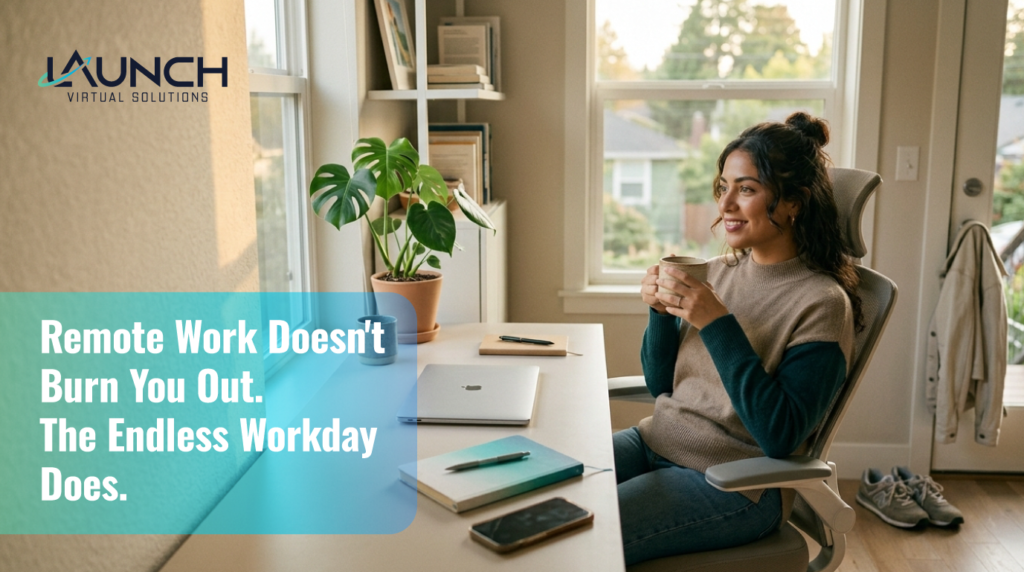
There’s a suspicion a lot of owners still carry, even if they’d never say it out loud in a team meeting: people working from home are probably slacking a little. The empty desk, the unseen hours, the 11 a.m. laundry. If that’s the quiet worry, here’s the more useful one — the data points the exact opposite direction, and the real risk isn’t your team doing too little. It’s them never stopping.
Let’s clear the myth first, then talk about the problem that actually costs you people.
The myth, quickly: remote work works
The most rigorous study we have on this is Nicholas Bloom’s Stanford experiment, published in Nature in 2024 — a controlled trial with more than 1,600 workers. The result that should end the argument: hybrid work had no negative effect on productivity, performance reviews, or promotions. None. What it did do was cut resignations by 33%, and employees valued the option to work from home about as much as an 8% raise.
Here’s the detail worth sitting with: the managers in the study predicted productivity would fall. They were wrong, and by the end of the experiment they’d changed their minds. The instinct that remote equals lazy is common, confident, and not supported by the evidence.
So if remote work isn’t the problem, what is?
The real problem: the workday that forgot to end
When people left an office at 6 p.m., the day ended. Not because they were disciplined — because the building made them. The commute, the lights going off, the coworkers packing up: the office was quietly running a shutdown routine on your behalf every single day.
Take the building away and that shutdown never runs. Microsoft’s researchers gave the result a name: the «triple peak day.» Knowledge workers used to have two productivity peaks — before lunch and after lunch. Working from home, a third one appeared, in the hours before bed. Their Work Trend Index found the average Teams user now sends 42% more messages after hours, and a study of 60,000+ employees found remote work drove a 10% jump in weekly hours.
One of the Microsoft researchers put the danger in one sentence: «If people are working all three peaks, that’s a recipe for early burnout.»
And honestly? You already know this one from the inside. The office at least had the decency to physically eject you. Your kitchen table has no such policy. It has never once looked up at 7 p.m. and said «go home» — you are home, that’s the whole problem, and so the laptop stays open «just to finish one thing» until finishing one thing is a personality trait. The commute you used to complain about was doing unpaid emotional labor as the wall between work-you and couch-you, and nobody appreciated it until it was gone.
That’s the shift that quietly burns out remote teams. Not slacking. The absence of a wall.
What the office was really giving you: boundaries
This is where it helps to borrow from someone who studied it long before it was a pandemic headline. The sociologist Christena Nippert-Eng, in her book Home and Work, described how we all sit somewhere on a spectrum between «segmentors» — people who need a hard line between work and life — and «integrators,» who blend the two comfortably. Neither is better. Segmentors thrive on clear separation; integrators thrive on flexibility. The trouble starts when you don’t know which one you are, and you let the day decide for you.
Her key insight is the one every remote team should internalize: the office gave you boundaries for free. Physical (a different location), temporal (fixed hours), and social (different people). Remote work strips all of that away — and if you don’t rebuild those boundaries on purpose, they simply don’t exist. A sustainable remote routine isn’t about willpower or a nicer desk. It’s about deliberately reconstructing the walls the office used to build for you.
For a segmentor drowning at home, the fix might be a hard 6 p.m. stop and a closed door. For an integrator, it might be permission to work in bursts without guilt. Same problem, opposite solutions — which is exactly why generic «work-life balance» advice bounces off most people.
It’s not just your hours. It’s your attention.
There’s a second cost to the boundaryless day, and it’s subtler than long hours: shredded attention.
Gloria Mark, a researcher at UC Irvine who has measured this for two decades, found that the average time a person now spends on a single screen before switching is 47 seconds. In 2004 it was about two and a half minutes. And once you’re interrupted, it takes an average of 25 minutes to get back to the original task. Her most uncomfortable finding for remote workers: alone at home, we interrupt ourselves more than anyone else interrupts us. The open tab, the phone, the «quick check» — the enemy is largely us.
Cal Newport, in Deep Work, drew the line that matters here: deep work (focused, valuable, cognitively demanding) versus shallow work (email, coordination, logistics — done on autopilot). His warning is that shallow work has quietly colonized the professional day. When your best people spend their sharpest hours answering messages and chasing updates, the work that actually moves the business — the deep work — gets done in the leftover scraps, if at all.
Put Mark and Newport together and the picture is clear: a sustainable routine isn’t only about protecting your hours. It’s about protecting the blocks of attention where real work happens — and defending them from a hundred small interruptions, most of them self-inflicted.
What’s in your control
You can’t reinstall the commute. But you can rebuild what it gave you:
- Design a fake commute. A ten-minute walk before and after work recreates the temporal boundary your drive used to. It signals the brain: on, then off.
- Figure out if you’re a segmentor or an integrator — and build the routine around that, not around what works for someone on LinkedIn.
- Protect one deep-work block a day. Even 90 uninterrupted minutes. Phone in another room. That’s where the value lives.
- Make the third peak a choice, not a default. Working at night is fine if you chose it. It’s a warning sign when it’s just the day overflowing.
- Cut the self-interruptions first. They’re more common than the external ones, and they’re the ones you can actually control.
- Offload the shallow work. If email, scheduling and coordination are eating your team’s sharpest hours, that’s not a discipline problem — it’s a capacity problem, and it has a different fix.
Give your team their focus back
Here’s the honest bridge, because a routine alone doesn’t solve everything: the shallow work doesn’t disappear when you get organized. Someone still has to answer the messages, book the calls, chase the documents, and keep the day moving. If that someone is you or your most valuable people, you’re spending your best attention on autopilot tasks — and no boundary, however well-drawn, survives a workload that’s simply too big for the people carrying it.
That’s the piece a virtual assistant actually solves. Not by pushing your team to grind harder, but by taking the shallow work off their plates so they can protect the deep work — and hold the line between work and life instead of watching it dissolve.
At Launch Virtual Solutions, we find, train, and integrate professional bilingual virtual assistants based in Latin America, working in your time zone, ready to absorb the operational load that keeps your team’s laptops open past dinner. Compared with a local hire, it costs 40% less on base salary, up to 55% all-in.
Tell us what’s keeping your team online at 9 p.m., and we’ll help you close the laptop.
Book your free consultation today.
This article discusses workplace wellbeing and burnout for informational purposes and is not medical advice. If you or someone on your team is struggling personally, a qualified health professional is the right place to start.
Sources
- Nicholas Bloom et al., «Hybrid working from home improves retention without damaging performance,» Nature (2024) — Stanford SIEPR: nature.com
- Microsoft WorkLab — «The Rise of the Triple Peak Day» (2021) & Microsoft Work Trend Index: microsoft.com
- Gloria Mark, Attention Span: A Groundbreaking Way to Restore Balance, Happiness and Productivity (Hanover Square Press, 2023) — research at UC Irvine.
- Cal Newport, Deep Work: Rules for Focused Success in a Distracted World (Grand Central Publishing, 2016).
- Christena Nippert-Eng, Home and Work: Negotiating Boundaries in Everyday Life (University of Chicago Press, 1996).
- Sophie Leroy, «Why is it so hard to do my work?» Organizational Behavior and Human Decision Processes (2009) — attention residue.